
Speak With Our Experts
Best Ayurvedic Treatments for Asthma — Breathe Freely
Natural Remedies to Strengthen Lungs & Stop Wheezing
Better Breathing Health Care Flow Life Energy
Asthma Cough at Night: Why It Wakes You Up and What You Can Do
If you have ever been jolted awake by a dry, hacking cough that seems to come from nowhere, you already know how frustrating nighttime asthma can be. That persistent asthma cough at night is not just annoying; it is your body’s way of telling you that your airways are inflamed and reacting to triggers that peak while you sleep. Unlike a regular cold cough, this one often appears without mucus, worsens when you lie down, and can leave you gasping for air or feeling tightness in your chest. For countless people, these nocturnal episodes become a cycle of lost sleep, daytime fatigue, and anxiety about the next sunset. At Khush Ayurveda, we believe understanding the root cause of this nighttime struggle is the first real step toward peaceful, uninterrupted rest. The good news is that with the right knowledge and a few smart changes, you can drastically reduce how often coughing at night asthma disrupts your life.
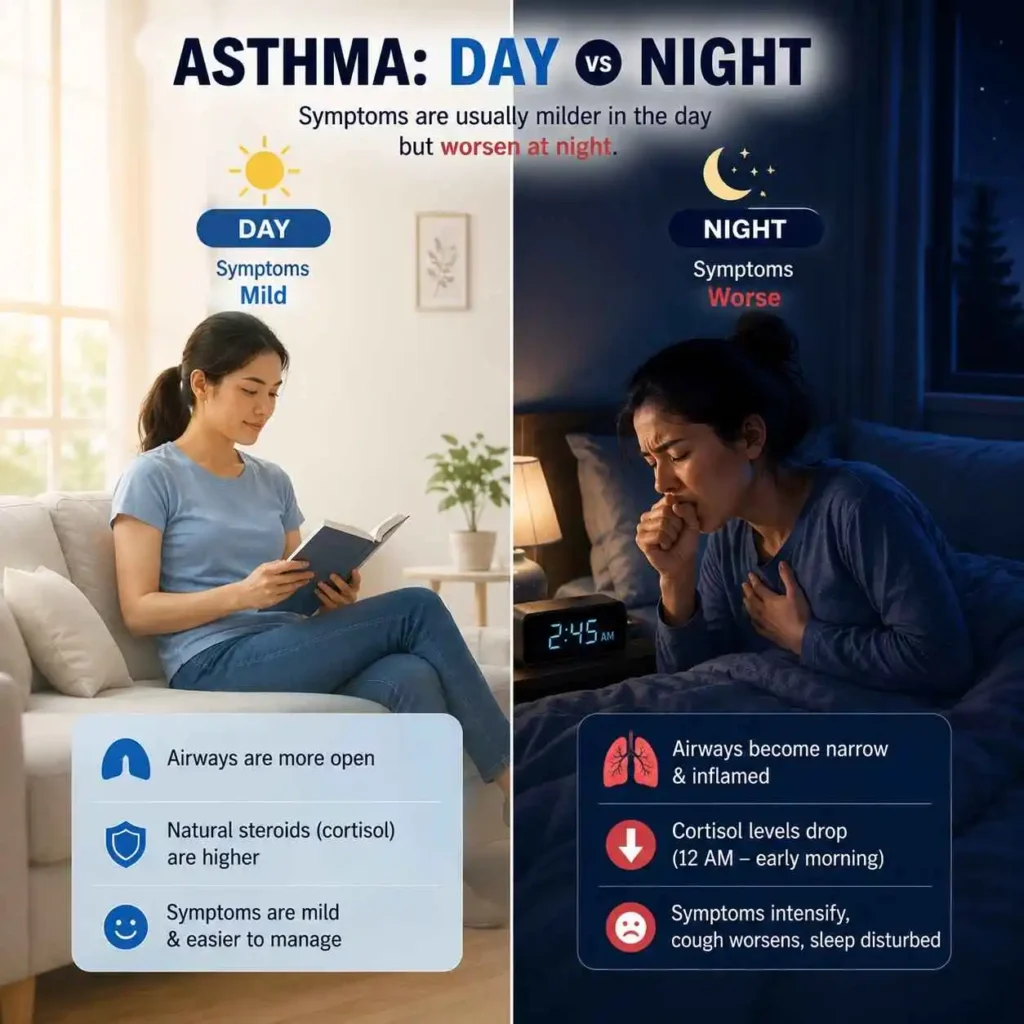
How Asthma Symptoms at Night Differ from Daytime Coughing
Many people assume asthma is an equal-opportunity condition, striking the same way regardless of the hour. That assumption could not be more wrong. Asthma symptoms at night – medically called nocturnal asthma – tend to be more intense, longer lasting, and harder to control than daytime episodes. During the day, your body produces natural steroids like cortisol that keep airway inflammation in check. But around midnight to early morning, cortisol levels drop to their lowest point, leaving your bronchial tubes vulnerable to swelling and constriction. This hormonal shift explains why your asthma cough at night often peaks between 2 a.m. and 4 a.m., precisely when you need deep sleep the most. Additionally, lying flat changes how your lungs expand, and gravity allows postnasal drip or acid reflux to irritate sensitive airway linings. Recognizing these differences is crucial because treating a nighttime asthma cough like a standard daytime cough can lead to ineffective remedies and worsening symptoms over time.
The MedlinePlus Medical Encyclopedia explains that coughing, especially at night, is one of the classic symptoms of asthma.
The Hidden Reasons Behind Night Time Asthma Symptoms
Let us get specific about what actually triggers night time asthma symptoms, because guessing rarely helps anyone breathe easier. First, your sleeping environment plays a massive role. Bedrooms often harbor dust mites in pillows and mattresses, mold spores in corners, and pet dander on blankets – all potent allergens that can provoke an asthma response when you inhale them for eight straight hours. Second, there is the temperature factor. Cooler nighttime air can cause airways to narrow, especially if you sleep with a window open or an air conditioner running. Third, your circadian rhythm influences airway resistance; studies show that lung function naturally dips by about 10 to 20 percent during sleep, even in healthy individuals. For someone with asthma, that dip can mean the difference between comfortable breathing and a violent asthma cough at night. Fourth, delayed treatment effects matter. If your last inhaler dose was taken at 6 p.m., its protective effect may wear off by midnight, leaving you unprotected during vulnerable hours. Understanding these triggers allows you to target them one by one instead of feeling helpless.
Exploring Asthma Cough Causes That Peak After Dark
When we dig into asthma cough causes specifically at night, three biological mechanisms stand out as the main culprits. The first is airway inflammation that follows a 24-hour rhythm. Your immune cells release more inflammatory chemicals like histamine while you sleep, which directly irritates bronchial tubes and triggers the cough reflex. The second major cause is gastroesophageal reflux disease (GERD), which flies under the radar for many asthmatics. When you lie flat, stomach acid can creep up into your esophagus and even trickle into your upper airways. This acid micro-aspiration acts as a powerful irritant, setting off coughing at night asthma even if you do not feel obvious heartburn. The third cause is postnasal drip from allergic rhinitis or sinus issues. As mucus accumulates in your throat during sleep, it triggers a chronic, ticklish cough that mimics asthma but actually stems from upper airway problems. In real-world practice, many patients have overlapping causes – for example, GERD making asthma worse, and postnasal drip compounding everything. That is why effective relief rarely comes from a single magic bullet but from a layered strategy.
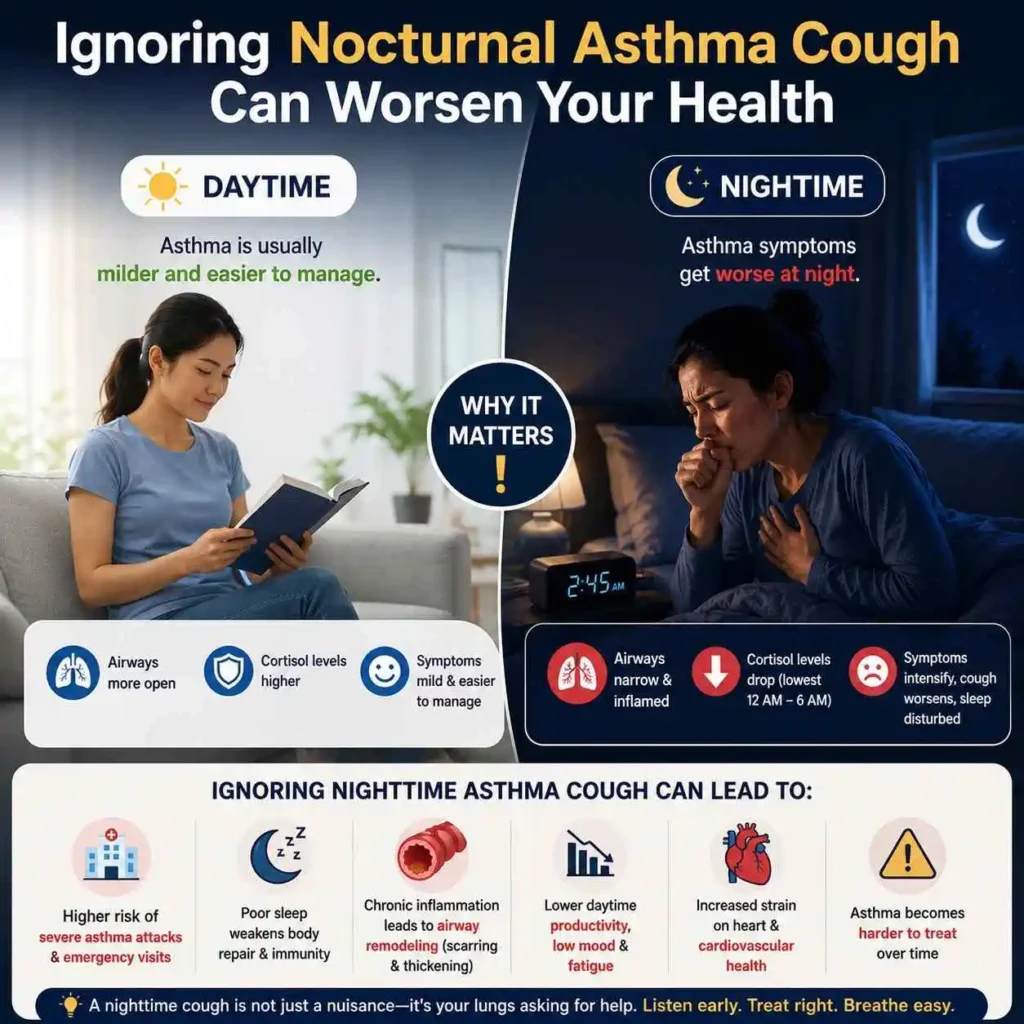
Why Ignoring Nocturnal Asthma Cough Can Worsen Your Health
Some people dismiss their asthma symptoms at night as just an annoyance, assuming it will go away on its own or that occasional coughing is harmless. This mindset can be dangerous. Frequent nighttime awakenings due to coughing or wheezing are actually a marker of poorly controlled asthma, and studies link them to a higher risk of severe asthma attacks requiring emergency care. When you lose sleep night after night, your body’s repair mechanisms fail, inflammation spreads, and your airways become increasingly sensitive to smaller triggers. Over months, untreated night time asthma symptoms can lead to permanent airway remodeling – a fancy term for scarring and thickening of bronchial walls that makes asthma harder to treat forever. Furthermore, daytime productivity, mood, and even cardiovascular health suffer when your sleep is constantly fragmented. Recognizing that a persistent asthma cough at night is not a minor inconvenience but a medical signal is essential. It is your lungs asking for attention, and ignoring that request rarely ends well.
A study on PubMed shows that nocturnal asthma is marked by increased corticotropin levels that are not accompanied by commensurate increases in cortisol levels.
Practical Steps to Reduce Asthma Cough at Night Without Relying Solely on Medication
While prescription inhalers and controllers have their place, you can take immediate, actionable steps at home to calm coughing at night asthma starting tonight. First, invest in allergen-proof mattress and pillow covers. These create a barrier against dust mites, one of the most common triggers for nocturnal asthma. Wash your bedding weekly in hot water (above 130°F or 54°C) to kill mites and remove pollen that hitched a ride on your clothes. Second, elevate the head of your bed by six to eight inches. You can use risers under the bedposts or a foam wedge under your mattress. This simple tilt uses gravity to reduce acid reflux and postnasal drip, both of which trigger asthma cough at night. Third, run a HEPA air purifier in your bedroom continuously, especially during allergy seasons. Fourth, keep your bedroom temperature consistent and not too cold – aim for 68 to 70°F. Fifth, avoid eating heavy meals or spicy foods within three hours of bedtime, as these worsen reflux. Sixth, consider a warm shower before bed; the steam helps open airways and clear mucus. These non-drug interventions create a breathing-friendly sleep environment that works alongside any medical plan.
The Role of Hydration, Humidity, and Breathing Techniques
You might not associate water vapor with asthma symptoms at night, but humidity levels dramatically influence how easily you breathe while sleeping. Dry air – common in heated homes during winter or air-conditioned rooms in summer – pulls moisture from your airway linings, making mucus thicker and more irritating. This dryness directly provokes an asthma cough at night in many people. Using a cool-mist humidifier in your bedroom can maintain optimal humidity between 40 and 50 percent, which keeps mucus thin and easier to clear. However, be cautious: too much humidity encourages mold and dust mites, so use a hygrometer to measure. Hydration from the inside matters just as much. Drinking warm water or herbal tea (non-caffeinated) before bed helps thin secretions, but stop fluids an hour before sleep to avoid nighttime bathroom trips that disturb rest. Additionally, practicing pursed-lip breathing or diaphragmatic breathing for five minutes before lying down can reduce airway resistance. Here is a simple technique: inhale slowly through your nose for two seconds, then exhale gently through pursed lips for four seconds. This prolongs exhalation, keeps small airways open, and can prevent that desperate coughing at night asthma feeling.
When to Seek Medical Help for Night Time Asthma Symptoms
Even with excellent home management, some cases of night time asthma symptoms require professional evaluation. You should contact your doctor if you experience any of the following: your asthma cough at night wakes you more than twice per week despite using your prescribed controller medication; you wake up gasping or feeling like you cannot catch your breath; your peak flow readings drop by more than 20 percent in the morning compared to evening; you need to use your rescue inhaler more than two nights per month; or you develop new symptoms like bluish lips, confusion, or difficulty speaking full sentences (which are emergency signs). A physician may adjust your medication timing – for example, moving a once-daily controller inhaler from morning to evening or adding a leukotriene modifier that specifically targets nighttime inflammation. They might also test for allergies, GERD, or sleep apnea, all of which can masquerade as or worsen nocturnal asthma. Remember, well-controlled asthma should not regularly rob you of sleep. If it does, your treatment plan needs an upgrade, not just patience.
How an Ayurvedic Perspective Addresses Asthma Cough at Night Differently
Modern medicine focuses on suppressing inflammation and opening airways, which is essential in emergencies. But an Ayurvedic approach – like the one embraced at Khush Ayurveda – looks at why your body became vulnerable to asthma cough at night in the first place. According to Ayurveda, asthma (known as Tamaka Swasa) is primarily a disorder of Vata and Kapha doshas, with Kapha accumulating in the lungs during the Kapha time of night (roughly 6 p.m. to 2 a.m.). This excess Kapha produces mucus, heaviness, and congestion, while disturbed Vata causes the dry, spasmodic cough and airway constriction. Rather than just attacking symptoms, an Ayurvedic protocol might include dietary adjustments to reduce Kapha-forming foods (like dairy, fried items, and cold desserts), specific breathing exercises (Pranayama such as Anulom-Vilom), herbal formulations containing ingredients like Vasa (Adhatoda vasica), Tulsi, and Yashtimadhu, and nightly oil massage (Abhyanga) to calm Vata. Many individuals who have struggled with coughing at night asthma for years find relief when they combine modern asthma action plans with these time-tested principles. The key is consistency and personalization – no two asthma patients have identical doshic imbalances.
Creating Your Personal Action Plan for Peaceful Nights
Now that you understand the mechanisms, triggers, and solutions for asthma cough at night, it is time to build a simple, repeatable plan you can start tonight. Begin by tracking your symptoms for one week. Note the time you go to bed, when coughing wakes you, what you ate for dinner, your bedroom humidity, and whether you used any medication. This log will reveal patterns unique to you. Next, pick two or three environmental changes from the practical steps above – for instance, washing bedding in hot water and using a humidifier – and commit to them for ten days. Then, review your night time asthma symptoms to see if frequency or intensity dropped. If not, add another layer like head-of-bed elevation or an air purifier. Do not try all changes at once; you will not know what actually works. And if you use rescue medication more than twice a week for coughing at night asthma, call your doctor for a controller medication review. Finally, consider exploring holistic support. Many people find that a thorough evaluation from an Ayurvedic practitioner, such as through Khush Ayurveda, helps identify underlying digestive or immune weaknesses that conventional tests miss. Sleep is not a luxury; it is biological necessity. Your lungs deserve to rest just as much as your brain does.
Final Thoughts: You Can Control Asthma Cough at Night
Living with a asthma cough at night can make you dread bedtime, turning your bedroom into a battleground instead of a sanctuary. But you are not powerless. By understanding the unique physiology of nocturnal asthma – the hormone dips, the allergen exposure, the GERD connection – you can dismantle the problem piece by piece. The most successful approach is rarely a single wonder-drug or one lifestyle hack; it is a thoughtful combination of medical guidance, environmental control, and sometimes a deeper shift in how you nourish and balance your body. Khush Ayurveda encourages you to see nighttime asthma not as a life sentence but as a signal your body is sending. Listen to that signal, respond with specific action, and give yourself permission to experiment until you find what works for your unique constitution. You deserve nights of deep, uninterrupted sleep and mornings where you wake up actually feeling rested. Start with one small change tonight, and let that momentum carry you toward calmer, clearer breathing.
Real Patients. Real Results.
Hear what patients across India say about their asthma treatment journey with Khush Ayurveda.
Doctor Explains Asthma – No Steroids, Just Herbs
Why your lungs are sensitive and how to fix it naturally
FAQs
Blame your body’s internal clock. Cortisol (your natural anti-inflammatory) drops after midnight. Histamine (cough trigger) rises. That perfect storm creates asthma cough at night even if your day is fine. Not your fault. Just biology.
Absolutely. You wake up coughing, panic sets in, and panic tightens your airways. Vicious cycle. Keep warm water by your bed. Sit up, sip slowly, breathe out longer than you breathe in. Works better than lying there frozen.
Honestly? No. More than twice a week means your asthma is not controlled. Do not just accept it. Something else is wrong – reflux, dust mites, or bad medication timing. Fix the root cause. At Khush Ayurveda, we see this all the time.
Try it for three nights. Some people find milk and yogurt thicken mucus and worsen asthma symptoms at night. Others are fine. You will know quickly. Your body does not lie.
Head elevation? First night sometimes. Washing bedding? Three nights. Humidifier? Same night if your air is dry. Change one thing at a time. Keep a notebook. People who track symptoms get better faster.
Yes, sadly. Feed them dinner earlier. No chocolate or soda before bed. Wash stuffed animals in hot water. If nothing helps, see a pediatric pulmonologist. Do not let anyone say “it is just a cough.” Khush Ayurveda recommends starting with dinner timing – it is free and it works for many kids.
Yes. Flat on your back is the worst position for most people. It lets acid creep up and mucus settle in your throat. Sleep on your left side instead. Something about the way your stomach angles. Try it tonight. Costs nothing.
More than you think. Spicy foods, chocolate, mint, fried stuff, and alcohol all relax the valve between your stomach and esophagus. That means acid travels up while you sleep. Eat dinner by 7 PM. Keep it light. Your coughing at night asthma might disappear in a week.
Warm ginger tea before bed. Not a cure. But it helps. Ginger reduces inflammation and calms the cough reflex. Add a pinch of turmeric if you have it. People at Khush Ayurveda have used this for decades. Does it replace your inhaler? No. Does it reduce how often you need it? Often yes.
Some nights are just bad. Asthma is unpredictable. Do not blame yourself. Have a rescue plan ready. Inhaler, warm water, slow breathing. If nothing helps after twenty minutes, wake someone up or go to urgent care. Do not be a hero. I have made that mistake. Not worth it.
Yes, especially if you have silent reflux. Extra belly fat pushes stomach acid up when you lie down. Losing even five percent of your body weight can reduce asthma symptoms at night significantly. Not easy. But worth knowing.
Related Health Articles



Our Ayurvedic Treatment Services
Hydrocele Treatment Without Surgery – No knife, no hospital. Natural healing.
Varicocele Treatment Without Surgery – Ayurvedic care for varicocele.
Piles Treatment in Ayurveda – Stop bleeding and pain naturally.
Asthma Treatment in Ayurveda – Breathe freely without steroids.
Sexual Wellness for Men – Restore confidence and stamina naturally.
Kidney Treatment in Ayurveda – Lower creatinine, avoid dialysis.
Fatty Liver Treatment in Ayurveda – Reverse fatty liver naturally.
Natural Diabetes Treatment – Control sugar without side effects.
Acidity Treatment in Ayurveda – Stop gas and burning permanently.